
The Individual Legal Needs Survey background:
In September 2023, the LSB completed its main annual research project, which this year was the Individual Legal Needs Survey (ILNS). The ILNS is commissioned every four years by the LSB and The Law Society and is the leading piece of research in understanding how people’s legal needs can be best met. Historically, the survey has been used to direct research projects and assist legal support charities with applications for funding. It identifies a broad range of facts, views and trends around the provision of legal services. This includes understanding the rate at which people encounter legal issues, the extent to which people have legal needs and the proportion of these needs that go unmet.
The latest wave of the survey was taken by over 17,000 individuals across England and Wales and was based on a representative nationwide sample selected by YouGov. The sample is taken from the adult population and identifies all those who had a legal issue from September 2019 to September 2023. The survey is weighted to ensure that all findings are representative of England and Wales and can be used to calculate the precise number of individuals who will have experienced a legal issue since the last survey was conducted. This year, the survey was also weighted by ethnicity, improving its representativeness.
The ILNS’ core purpose:
The ILNS is the LSB’s flagship piece of research, and it primarily identifies how many people in England and Wales have experienced a legal problem. The survey asked 30 questions to identify if an individual experienced a problem that was legal in nature, even if they were not aware themselves that they had experienced such an issue.
Once these individuals had been identified, the survey went on to ask a range of questions that enabled the LSB to identify the proportion of people who had encountered an unmet legal need. Individuals who had problems high in difficulty and were unable to get professional help are far more likely to show having developed unmet legal needs.
Findings on unmet legal needs:
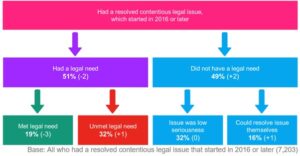
The survey found that whilst there had not been an increase in the proportion of individuals experiencing a legal issue, there was a 1-point percentage increase in the proportion of individuals who had developed an unmet legal need, see Figure 1. This finding was likely a result of a 3% decrease in people getting professional support. This indicates that there may not be the supply of legal services needed to meet current demand and that individuals may not know where to go to secure legal services that can address their problem. This suggests greater education about legal services is needed and national agencies could be used to help direct people to the legal services they require.
The survey also found that this increase can be partly explained due to big events that have affected the economy. For instance, 15% of individuals felt that their issue had been caused by the cost-of-living crisis, with 25% of such people thinking it had made their issue harder to deal with. Therefore, the squeeze on many individuals’ finances may have limited their ability to afford legal services, potentially raising greater demand on legal aid services that may not be able to assist all those who need support to resolve legal problems.
Further, 12% of people felt their issue had been caused by the pandemic, with 23% of these individuals stating their issue had been harder to solve because of the pandemic. This would indicate that the pandemic may have restricted people’s ability to physically see a professional who could have dealt with their problem or get access to a court that could resolve their case.
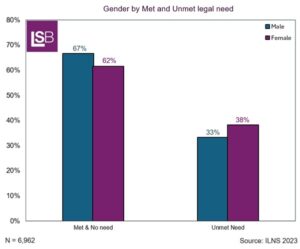
Critically, the survey also found that some socio-economic groups were more likely to experience unmet legal needs than others. For example, women were 5% more likely to have developed an unmet legal need than men, see Figure 2. This may have been because they were more likely to face legal issues that require more specialist services that are harder to resolve, such as domestic abuse cases Individuals whose first language was not English were 6% more likely to develop unmet legal needs, possibly because they found it harder to secure a professional. 5% more of those on a low income, £32,000 or less, had encountered unmet legal needs than those on higher incomes, £60,000 or above, likely due to those on lower incomes . Individuals who identified as being limited by a disability were 7% more often recorded as having an unmet legal need than individuals without a disability.
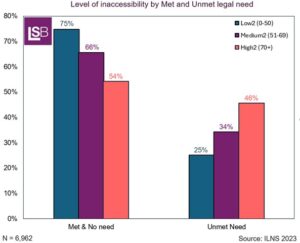
Individuals lower in confidence were 16% more likely to be identified as having legal needs going unmet than those high in confidence, see figure 3. Further, those high in inaccessibility to legal services were 10% more likely to have developed unmet legal needs than those with lower levels of inaccessibility. This is likely because those low in confidence and high in accessibility were more likely to feel they did not know where they could go to secure legal services.
For greater depth and understanding to why these trends developed, please see our summary report here. A more detailed report will be published and linked in due course.
If you’re interested in this research and want to know more or get involved, please reach out to the LSB Research team at research@legalservicesboard.org.uk.

More stories


