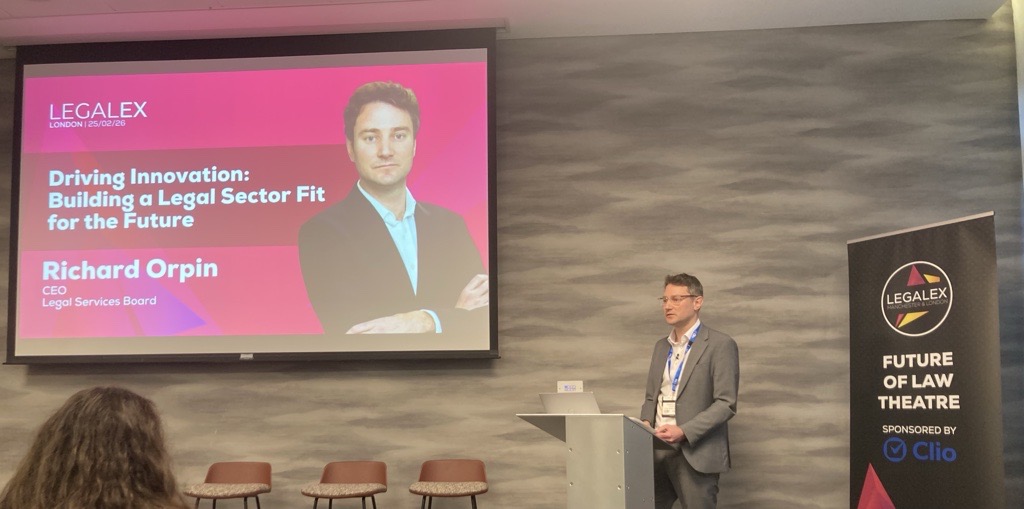
Richard Orpin, Chair of the Legal Services Board, delivered a speech at LegalEx London on 25 February 2026. The speech is below. Check against delivery.
Speech by Richard Orpin
Good morning. I’m Richard Orpin, and as the newly appointed CEO of the Legal Services Board, it’s a privilege to be here at LegalEx.
I want to start with a number that should make every person in this room sit up: £52.3 billion.
That’s the revenue generated by legal activities in the UK in 2024, up from £41.4 billion in 2021.
Legal services is a huge economic success story and a sector that matters enormously—to the people it serves, to business, to economic growth, and to the rule of law.
But here’s the other side of the story.
- One in five people with a legal need receive no professional help at all.
- Unmet legal need remains at almost a third of those with a contentious legal issue
- Only one in four small business seek professional advice for legal issues in 2020, and just 10% of small businesses see lawyers as cost-effective. So we have a paradox.
A growing, dynamic sector—and a stubborn, persistent failure to reach the people who need it most.
This paradox should concern all of us.
As the incoming CEO of the LSB, I want to ensure regulation helps to address that paradox. And I believe that technology and innovation will be central to the solution.
For years, we’ve talked about the need to embrace innovation in legal services. Quite rightly. And our research shows that following the pandemic, there was a step change in the use of innovation and technology to develop and deliver legal services.
So, the question now isn’t whether innovation is happening. It is—and faster than ever.
The question now is bigger:
Can regulation keep pace with the world that is rapidly arriving? And how can regulators ensure their regulatory frameworks enable innovation – so that more people can access the services they need – while ensuring consumers are adequately protected from harm.
Where We’ve Got To: The Foundation We’ve Built
Before we think about how we might start to answer those questions, let me briefly take stock, because it forms the foundation for what comes next.
In the last two years:
- We have issued statutory guidance to regulators on promoting technology and innovation.
- We published our Pro-Innovation Approach to AI
- We set out clear expectations for how regulators should support the safe and responsible use of artificial intelligence.
Our message is clear: regulation must be open to responsible innovation, not a barrier to it. That guidance is now being implemented, and we’re tracking progress in how the frontline regulators we oversee are acting on it.
We run a quarterly Innovation and Technology Forum for regulators.
Our Board is keen to hear from innovators firsthand. Garfield AI—the first AI-powered law firm to be authorised by the SRA—and Citizens Advice’s who have developed Caddy AI to help advisors quickly locate and share information from reliable sources have presented at our Board events. Excitingly, these aren’t pilots or prototypes. These are real products serving real people in real time.
And there are many similar examples across the sector.
So, I am proud to observe that the regulatory framework is open to innovation.
But, and this is important, being open to innovation is no longer enough.
Because the landscape is shifting under our feet.
The Pace of Change: What the Data Tells Us
Our State of Legal Services 2025 report—published last December—paints a striking picture.
- More providers and consumers are using digital tools than ever before.
- Consumer behaviours and expectations are shifting rapidly.
- And generative AI, which barely featured in our original 2020 State of Legal Services report, is now a defining feature of the landscape.
Meanwhile, the unregulated sector is large and growing. Our own research suggests it may account for around 9% of the total market for individuals’ legal needs—and up to 39% for small businesses. In some areas, like will-writing, it is likely to be much higher still.
The sector looks very different to the one in which the Legal Services Act 2007 was introduced in to nearly 20 years ago. And when the world changes— regulation needs to change too.
I want to outline three areas where I believe regulation needs to go further.
First: understanding and protecting consumers in an AI-enabled world.
We are currently conducting consumer research to understand what people actually expect from AI-powered legal tools—what they see as the opportunities, what worries them, and what safeguards they want. The early findings are striking.
Consumers are thoughtful, not naïve. They understand that AI tools vary in quality. They are deliberating thoughtfully about the need for human involvement and accountability—what some of our participants have what could be described as “a human in the loop and a human on the hook.”
But they also show a troubling acceptance—or perhaps resignation—to tiered services, where paid-for options are assumed to be better quality.
That raises a fundamental regulatory question: What are the minimum standards for AI legal tools that ordinary people should be able to rely on?
We will publish the full findings of this research later this year. But I can say already that it is pointing us towards harder questions than simply whether consumers can access AI legal tools. It is pointing us towards whether those tools are genuinely trustworthy—and whether we have the right mechanisms to ensure they are.
Second: the unregulated sector and the case for voluntary standards.
The growth of the unregulated sector is one of the most significant structural shifts in legal services.
AI is accelerating this.
Consumer-facing AI legal tools don’t always come from regulated law firms. They come from technology companies, legal tech start-ups, and a whole range of providers who sit entirely outside the regulatory perimeter.
Our mandate under the Legal Services Act includes powers under section 163 to enter voluntary regulatory arrangements—to accredit self-regulatory schemes run by others, or to publish registers of accredited providers. We have never used those powers. I think the time is coming when we must consider doing so.
Our landscape review—mapping existing standards for relevant to AI-powered legal tools—is designed to help us understand where the gaps are. Where voluntary standards could provide meaningful protection without creating unnecessary barriers to innovation. And where accreditation could help consumers navigate a confusing and opaque market.
I want to be clear: I am not proposing to regulate everything. That would be disproportionate and counterproductive. But I do think there is a strong case for establishing a clear framework of minimum quality standards for consumer-facing AI legal tools—one that industry can voluntarily adopt, that consumers can recognise, and that we can hold up as a benchmark. The alternative is a market where consumers cannot tell the trustworthy from the dangerous.
Third: the growing case for a review of reserved activities.
This is the most significant point I want to raise today, and I raise it deliberately—because I think it needs to be part of our national conversation about the future of legal services.
The list of reserved legal activities—set out in 2007—has not been substantively reviewed since.
But the market has changed beyond recognition.
AI is blurring the boundaries between regulated and unregulated legal advice. New business models are emerging that don’t map neatly onto the categories the Act anticipated.
The Mazur judgment last year brought into sharp focus how much complexity and uncertainty exist around the boundaries of reserved activities like the conduct of litigation—and how much is at stake for consumers and professionals alike.
Our 2022 mapping of the unregulated sector found that it is large, diverse, and growing. And the question of whether the current scope of reservation is still calibrated correctly—whether it is protecting consumers in the right places, and not creating unnecessary barriers in others—is becoming harder to avoid.
I am not today announcing a full statutory review. The LSB has previously said that a statutory review of reserved activities requires a robust evidence base. That is still true.
But I am saying this: the case for such a review is growing, and we intend to make it.
We will be engaging with government and everyone across the sector on this question. We will use our forthcoming small business legal needs survey, and our continuing consumer research, to build the evidence base. We are currently conducting a broad programme of consumer research — looking at how people experience legal services today, what they expect from them, and how their needs and behaviours are shifting as the market changes. And we will be transparent about the conclusions that evidence is pointing us towards and inform our direction.
The Regulatory Challenge: Keeping Pace
The LSB exists to ensure regulation delivers outcomes that genuinely matter to consumers. As AI and technology reshape that market, our role becomes more important—not less.
But the frameworks we have were, for the most part, built for an analogue world, or at least for a world where the pace of change was manageable within existing structures.
- The Legal Services Act 2007 is nearly two decades old.
- The reserved activities list is older still.
- The unregulated sector is growing faster than ever before.
This is not a criticism of those who built those frameworks—they were right for their time. It is simply a fact that the world has moved, and regulation must move with it.
We are committed to being pro-innovation.


