We would like to thank everyone who responded to our consultation on the draft statement of policy, “Upholding professional ethical duties.”
We heard from regulators, representative and professional bodies, legal professionals, academics, consumer organisations and civil society groups. The consultation received an exceptionally high level of engagement, reflecting the interest in legal ethics.
Your insights have had a direct influence on the final policy. Here’s how.
You said: clarity is needed on the hierarchy of duties
Many respondents welcomed the policy being grounded in the professional principles from the Legal Services Act 2007 but asked us to be clearer about which duties take precedence when they come into conflict.
Our response: a stronger definition
We amended the definition of “professional ethical duties” to state that duties to the court, and duties to act with independence and integrity, override the duty to act in the client’s best interests where they conflict. This will help to reinforce a consistent, sector-wide understanding of ethical priorities.
You said: the policy must allow for flexibility across different professions
Regulators raised concerns that our expectations sounded overly prescriptive and risked a “one-size-fits-all” approach, at odds with the diverse nature of legal services and regulatory models.
Our response: emphasis on proportionality and tailored implementation
We added the clarification that regulators must pursue outcomes “taking account of the ethical risks and specific needs of their regulated community.” We also clarified that regulators may take different approaches, provided they can evidence how these meet the outcomes. A pre-implementation period will now begin, during which time we’ll work with regulators to help them develop tailored action plans.
You said: include all those who shape ethical culture, not only authorised persons
Several respondents noted that ethical behaviours are heavily influenced by employees, managers and owners who may not themselves be authorised persons.
Our response: clarity on the scope of the policy
We revised the policy to make clear it applies to “regulated persons”, including unauthorised employees and managers within authorised firms. This recognises their important role in supporting ethical decision-making.
You said: strengthen support for ethical decision-making and workplace culture
Respondents highlighted the value of clear guidance, supportive environments, and practical tools to help professionals manage ethical challenges in practice.
Our response: expanded expectations on support and culture
We amended Outcome 3 – which covers how authorised persons are supported and empowered to uphold their professional ethics duties – to make sure that regulators:
- support ethical decision-making in all circumstances, not just when professionals are challenged
- provide resources to help authorised persons to foster work environments that value ethical decision-making
- include self-employed practitioners and chambers structures in internal reporting expectations.
You said: intelligence gathering should be broader and more forward-looking
Stakeholders wanted regulators to use multiple data sources and focus on emerging risks.
Our response: broader expectations around intelligence-gathering
Outcome 2, on regulatory arrangements, now makes clear that regulators should gather intelligence on the circumstances in which ethical duties may be undermined, not just on known behaviours.
You said: evaluation should focus on impact, not unrealistic guarantees
Regulators asked for clarity in how to evaluate effectiveness without implying they can “ensure” ethical behaviour in all cases.
Our response: refined evaluation requirements
Outcome 5, on evaluating impact, has been updated so regulators must measure their effectiveness in meeting the four outcomes, rather than guaranteeing sector-wide compliance.
Next steps
To give an overview of what the policy covers, we’ve produced the one-pager below. Click to expand.
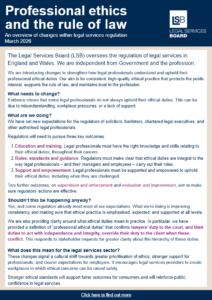
We will now work with regulators during a pre-implementation period as they develop their plans for pursuing the outcomes.
Find out more about our professional ethics programme of work here.
More stories


