Our Individual Legal Needs Survey (ILNS) gives us useful information about how and when people use legal services.
One of its questions asks recent users of legal services what their main method of communication with their provider had been. In our most recent survey, which included nearly 18,000 people across England and Wales, we saw a significant shift: in 2019, 41% of people said they had spoken to their lawyer face-to-face. By 2023, that number had dropped to 27%, a fall of 14 percentage points.
At the same time, the use of technology as the main method of communication increased. For example, between 2019 and 2023:
- telephone and email grew by five percentage points each
- websites and apps grew by two percentage points each
- video calls grew by three percentage points.

It’s likely that the Covid pandemic played a big part in this change. During lockdowns, face-to-face meetings weren’t possible, so providers had to turn to technological alternatives.
However, the trend continued into 2023, which suggests that the pandemic had a lasting effect on how providers communicate with their clients about legal services.
But what do consumers actually prefer?
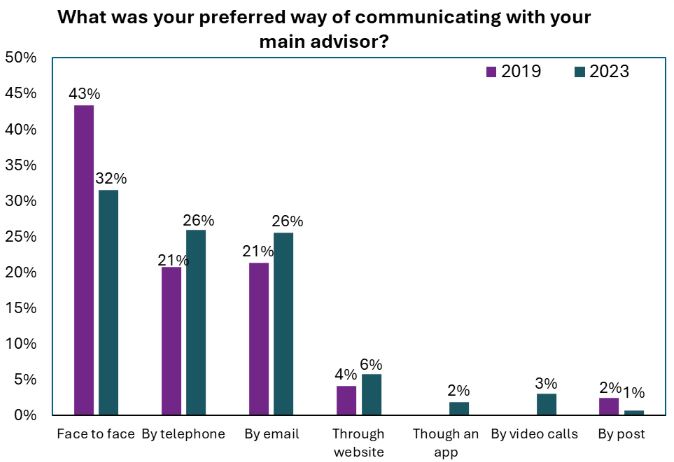
The survey also looks at how people prefer to communicate with their legal service providers, not just what happened in practice.
Between 2019 and 2023:
- preference for face-to-face contact dropped from 43% to 32% (an 11-point drop)
- preference for phone and email both rose by five percentage points
- preference for websites and apps both rose by two percentage points
- preference for video calls rose by three percentage points.
While face-to-face communication is still the most preferred option overall, technological methods are catching up. In fact, the gap between a preference for face-to-face and for telephone or email preference is now just six percentage points.
What does this mean for the legal services market?
More people are open to legal services being provided remotely. This could be good news for both consumers and providers.
Firms in certain parts of England and Wales can offer services at lower costs. If those services can be delivered remotely, more people might be able and willing to access them, even if the firm isn’t local.
Our next wave of this research – alongside our surveys on pricing and technology and innovation – will help show whether these changes are here to stay.

More stories


