I had the privilege of attending this year’s Annual Conference of the Legal Services Board at the beautiful King’s Trust venue in London. It was inspiring, illuminating, and at times sobering to be in a room full of individuals determined to reshape legal services. The insights offered at the event were shaped by a focus on solution-oriented discussions regarding the ‘how to’ of reshaping legal services to best benefit practitioners and consumers alike. Reflecting on the experience, I identified three key insights for legal regulators and practitioners that have stayed with me: (com)passion, solidarity, and collaboration. These concepts arose as foundational elements in addressing the core themes of this year’s event: making access to justice a reality, promoting EDI in the sector, and fostering professional ethics on par with the crucial work undertaken within the legal industry. This digest reflects my personal experience as a student supported by the LSB bursary scheme, which made this invaluable experience possible.
1) (Com)passion: A Pillar of Change
From the very beginning, the speakers at the conference emphasised how the legal services industry needs to shift its approach to consumers. As Dean Dunham highlighted, the legal profession has long been burdened by a reputation for elitism, making it difficult for many to perceive legal services as accessible or approachable. As he stated, many lawyers still wear their pinstripe suits and maintain an aura of exclusivity, failing to engage with the public in a way that fosters trust. What the industry needs, as Dunham emphasised, is compassion. Compassion is the key ingredient for regulators and practitioners in making access to justice a reality for all.
Tom Hayhoe pointed out that approximately 53% of people are not receiving the legal help they need, mainly due to issues such as the decline in legal aid funding. Dr. Liz Curran echoed this sentiment by urging attendees to stop focusing on why change is difficult and instead concentrate on creating a cultural shift, placing emphasis on what is possible, not what is hard.
This focus on compassion, underscored by passion, was echoed in the panel discussions, particularly in the session featuring David Abbott, Dan Hopewell, Laura Pinkney, Dr. Sarah Nelson, and Emma Bates. Their ideas on how compassion can tackle these access issues have further solidified my belief that the future of legal services must be grounded in empathy and a willingness to challenge the status quo. Particularly insightful was the way the panellists and hosts of the conference emphasised a deep and necessary understanding of the connectivity of legal services with other industries, highlighting that compassion can help us see more clearly where the problems needing attention coalesce.
2) Solidarity: The Need for Equal Action
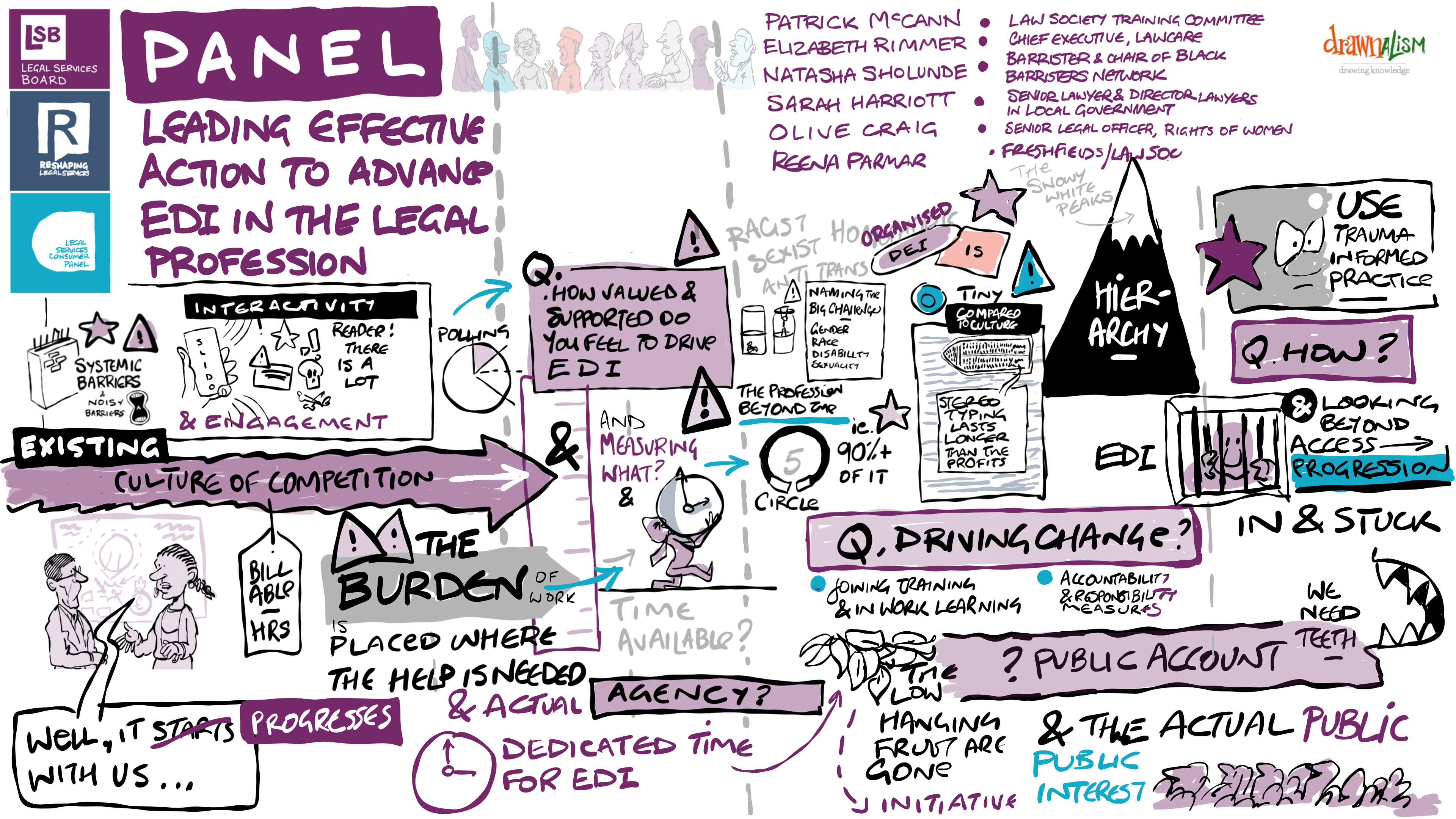
Equally powerful was the message of solidarity. When discussing equality, diversity, and inclusion (EDI), many panellists highlighted the stark reality of the lack of opportunities for marginalised groups within the profession. Debbie Foster’s presentation on the absence of support for disabled lawyers was particularly eye-opening and shocking. Many disabled lawyers are overlooked in the recruitment process, and those who do enter the profession often face career limitations.
As Dr. Natasha Shotunde pointed out, the onus of combating discrimination is frequently placed on those directly affected, and it is essential for privileged members of the sector to take an active role in fostering real, systemic change. Both Sarah Harriott and Elizabeth Rimmer emphasised that without effective regulatory structures and accountability measures, progress will be slow. This idea was reinforced by Reena Parmar, who called for a regulatory framework that prioritises cross-sector solidarity, holds parties accountable, and penalises poor behaviour.
Solidarity is the key to real, lasting change in the sector; it is a crucial solution to many issues the industry faces, as the LSB conference so importantly platformed. The panel made clear that what is needed are regulations which ‘have teeth’ and are supported throughout the sector via a sincere culture of solidarity.
3) Collaboration: The Path to Meaningful Change
One of the most profound discussions at the conference centred on collaboration. It became abundantly clear to me that transforming the legal services sector requires more than just individual efforts; it necessitates a collective approach. The power of collaboration across sectors—whether in health, welfare, or legal services—was emphasised by many speakers, including Dan Hopewell and Emma Bates.
Dan’s work in health-justice partnerships, which ensures that people receive the social welfare advice they need through healthcare providers, exemplifies how collaboration can effectively address legal access issues in a practical, sustainable way. Until the crucial insights offered at the event, I had never encountered a perspective that articulates legal issues as a health and welfare concern. The more I learned, the more I was convinced by the speakers’ emphasis that the sector does not face issues in a vacuum but must grapple with cross-sectoral challenges.
Collaboration thus became the key solution-oriented point of discussion at this year’s conference and inspired me greatly. As a student in the early stages of my career, I was particularly moved by the focus on uniting people across various fields to effectively reshape the sector for the betterment of the entire industry. The conference discussions, both within the presentations and in the riveting conversations that took place between attendees, reinforced collaboration as a vital ingredient for a solution-oriented approach to legal services. It crucially highlighted how no single profession, or sector can operate in isolation; rather, an industry so ingrained in the complex fabric of society demands both macro and micro collaboration efforts from within.
Concluding Thoughts
‘Reshaping Legal Services’ enabled me to connect with industry leaders, learn from insightful panel discussions, and feel inspired by passionate individuals dedicated to transforming the legal services landscape. This experience was not only educational but also empowering. Participating in this event reminded me of the importance of engaging in these conversations early in our careers, so we can carry these sentiments into our professional lives, as I now can. The support I received through the LSB bursary has undoubtedly shaped my understanding of the challenges and opportunities within the legal field. It reinforced my belief that, as future legal professionals, we must approach our work with compassion, solidarity, and a willingness to collaborate for a fairer and more ethical legal sector.
More stories


